The Challenge: Management of the right places at the right times
To cope with Australia’s dynamic environments, the movements of our inland waterbirds are themselves very dynamic. Many species like egrets, spoonbills and ibis are nomadic, moving vast distances each year to find food and nesting sites. They often depend on long periods of widespread flooding to breed in good numbers. Some species take years to reach breeding age, and don’t even breed at all if conditions aren’t right.
Australia has international legal obligations to protect both waterbirds and wetlands; but competing human needs for resources such as water, land and airspace make this challenging, and climate change predictions indicate it will not become any easier.
Improving understanding of the movements of our highly mobile waterbirds is essential to efficiently support their full life cycles, their populations and their habitats. It’s also important for other reasons, including understanding the movements of bird-borne diseases such as bird flu (avian influenza), and for assessing potential collision risks with wind energy infrastructure and aircraft.

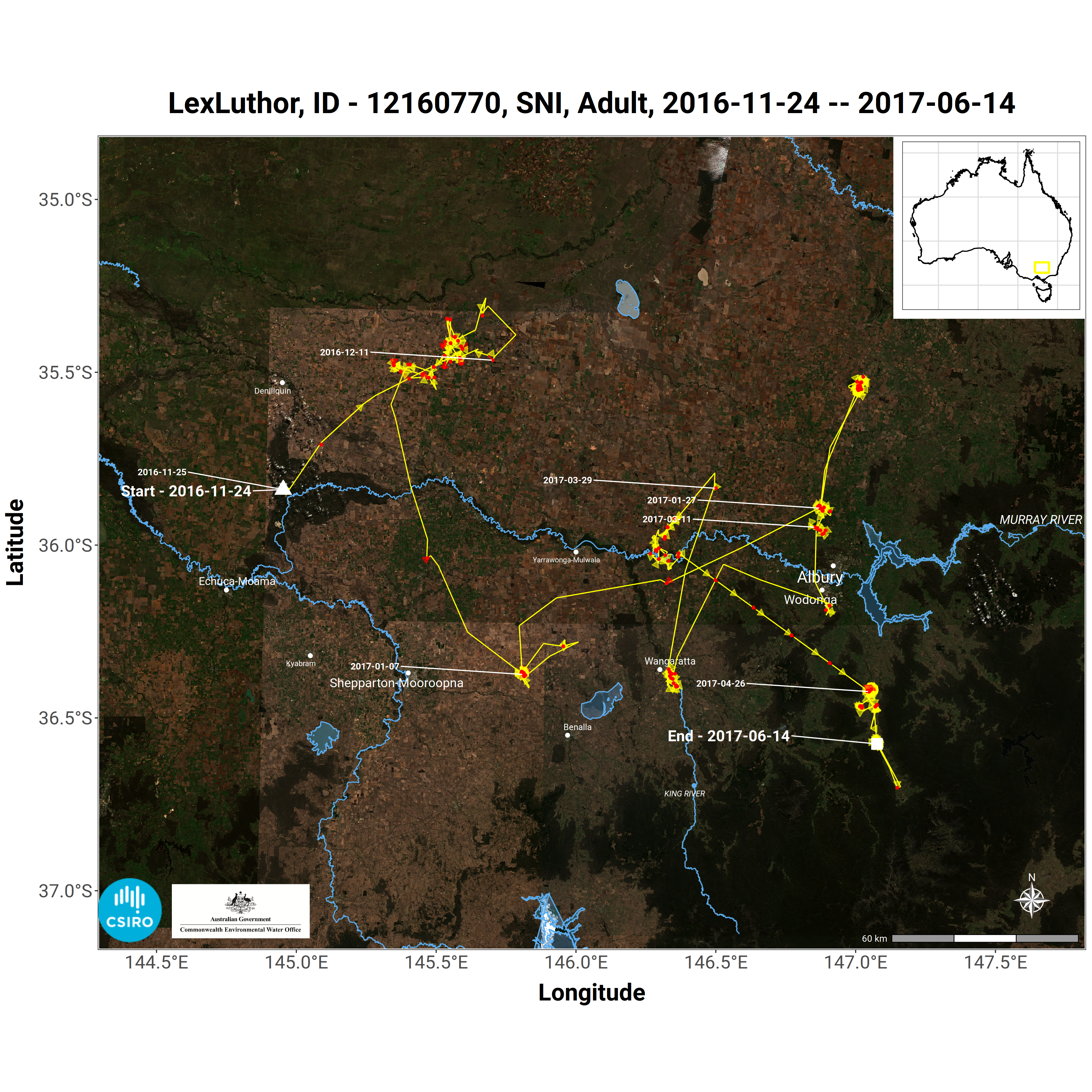
Movements of multiple waterbird species tracked from the Murray-Darling Basin by the CSIRO team since 2016. Image credit: CSIRO
Many people are surprised to discover how little we know about the movements and needs of our waterbirds, including large and common species. To fill these knowledge gaps, our team uses a range of approaches such as satellite tracking technology, drone surveys, remote monitoring cameras, on-ground survey and sampling, advanced mapping, and highly sophisticated modelling and prediction techniques.
Satellite tracking movements is particularly useful because can simultaneously reveal many things, such as:
- Movement routes and altitudes
- Movement strategies – nomadic, migratory, resident
- Site and habitat use & connectivity – important wetlands, timing
- Site fidelity – nesting, natal, foraging, overwintering
- Foraging – locations, distances, timing, habitats
- Nesting – locations, behaviour, timing, duration, habitats
- Differences – species, age groups
- Populations – boundaries and connectivity
- Survival and mortality – timing, drivers
- Cues and triggers – movement, breeding
These insights then inform where, when, and for how long resources or management are required to support or protect waterbirds and their habitats.
Contact our research lead for more information:
Dr Heather McGinness
Principal Research Scientist
Environment | CSIRO
Heather.McGinness@csiro.au | 02 62 46 4136